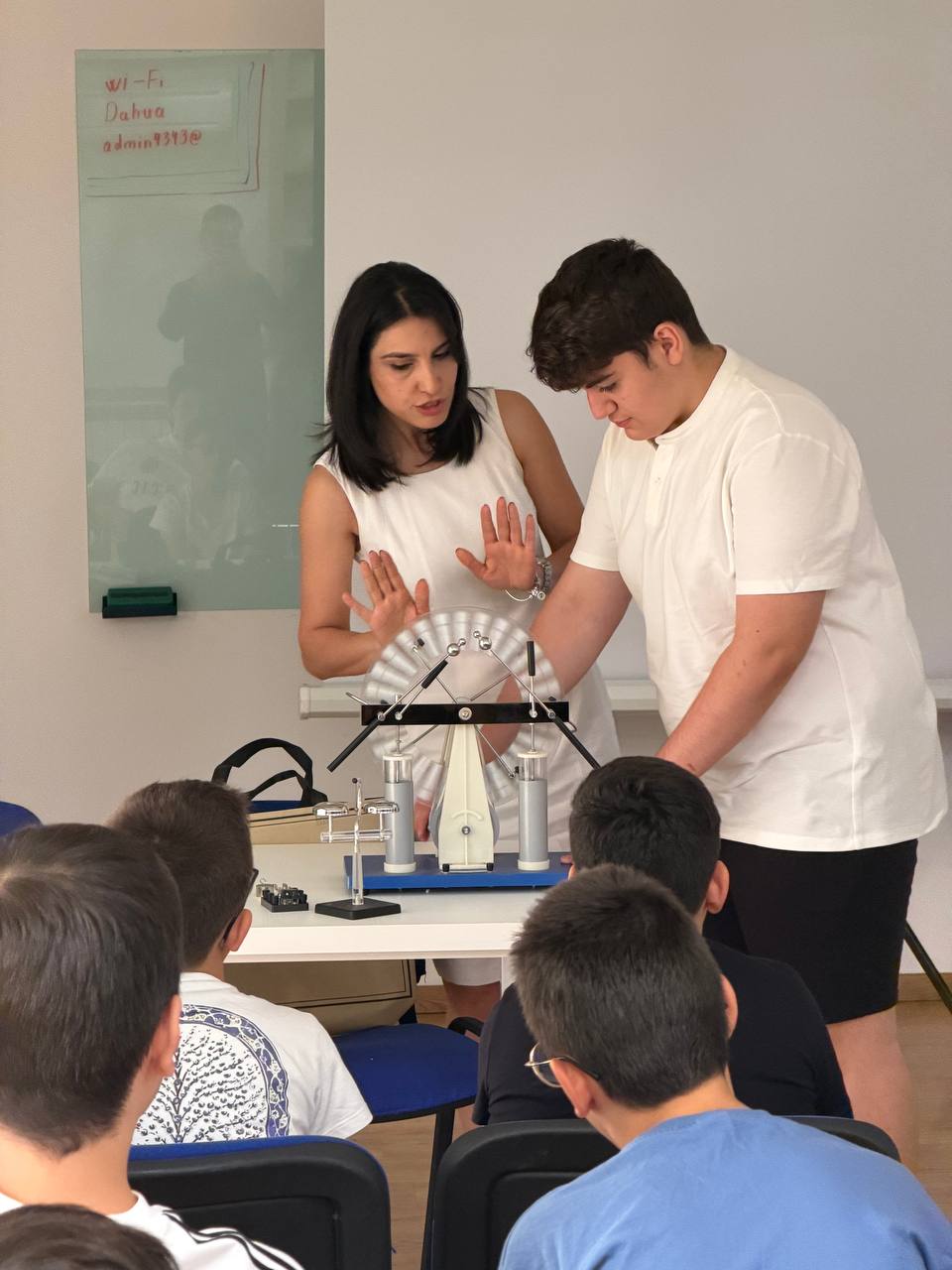
Summer School
Summer School introduces students to physics and engineering through active experimentation instead of memorization. Students build, test, observe, discuss and improve simple systems while connecting scientific ideas with real technologies such as circuits, sensors, robots, manufacturing, optics, sound, heat, pressure and space exploration. The program also includes visits to technology environments, scientific movie days, teamwork challenges and a final reflection or presentation depending on the selected option.
Advantages
- Physics and engineering are taught through experiments, challenges and real-life examples.
- Students visit robotics, manufacturing, science and space-related environments to connect lessons with industry.
- The program develops curiosity, teamwork, creativity, communication and practical problem-solving skills.
What is included in the program?
- 12 themed lessons built around practical physics and engineering activities
- Hands-on experiments with force, motion, circuits, optics, sound, heat, pressure and energy
- Visits to Smart Manufacturing and Robotics Lab, EC Factory, Science and Technology Museum, and Space Museum
- Scientific movie days with discussion about real science, engineering challenges and future technologies
- Video game day connected to physics, logic, strategy, systems and teamwork
- Option 1: 2 lessons / week · 6 hours / week
- Option 2: 4 lessons / week · 12 hours / week with final project presentation
Program modules
The program is organized as a connected learning path: theoretical foundations, practical labs, prototype development, testing, and presentation.
Week 1 · Lesson 1 — Physics and Engineering Introduction
Bridge, balance and friction challengesStudents are introduced to the camp, safety, teamwork and the idea that physics explains how the world works. They explore force, motion, balance, friction and gravity through simple experiments.
Week 1 · Lesson 2 — Electricity and Simple Circuits
LED circuit and motor demoStudents learn how batteries, wires, switches, resistors, LEDs and motors work by building and testing simple circuits instead of memorizing formulas.
Week 2 · Lesson 3 — Smart Manufacturing and Robotics Lab Visit
Robotics and automation observationStudents observe how robots, machines, sensors and automated systems are used in real engineering environments.
Week 2 · Lesson 4 — Scientific Movie Day: Space, Robots or Future Technologies
Technology concept discussionStudents watch a selected scientific movie or documentary and discuss what was real science, what was fiction and how one idea could be redesigned realistically.
Week 3 · Lesson 5 — Light, Optics and Vision
Periscope and optics experimentsStudents explore reflection, refraction, lenses and magnification while connecting optics with eyes, cameras, robots and space telescopes.
Week 3 · Lesson 6 — EC Factory Visit
Manufacturing process understandingStudents see how ideas become physical products and how design, materials, production, machines, testing and quality control work together.
Week 4 · Lesson 7 — Sound, Waves and Vibration
Sound and vibration experimentsStudents learn how sound is created, how waves move and how vibration is used in technology through experiments with strings, cups, speakers and simple sound devices.
Week 4 · Lesson 8 — Science and Technology Museum Visit
Science and invention reflectionStudents explore historical and modern technologies and connect museum exhibits with physics topics from the camp.
Week 5 · Lesson 9 — Heat, Energy and Pressure
Pressure and heat experimentsStudents explore thermal energy, heat transfer, air pressure and energy transformation through safe demonstrations that make invisible forces visible.
Week 5 · Lesson 10 — Scientific Movie Day: Engineering Challenges and Discovery
Engineering challenge activityStudents watch a second scientific movie or documentary focused on invention, exploration or problem solving, then solve a team challenge inspired by it.
Week 6 · Lesson 11 — Space Museum Visit
Space science connectionStudents learn about rockets, satellites, astronauts and the physics needed for space exploration, including motion, gravity, energy and communication.
Week 6 · Lesson 12 — Video Game Day: Physics, Logic and Team Challenges
Team challenge and final reflectionStudents complete selected educational or physics-based game challenges and discuss what systems, logic, engineering or physics appeared in the game.