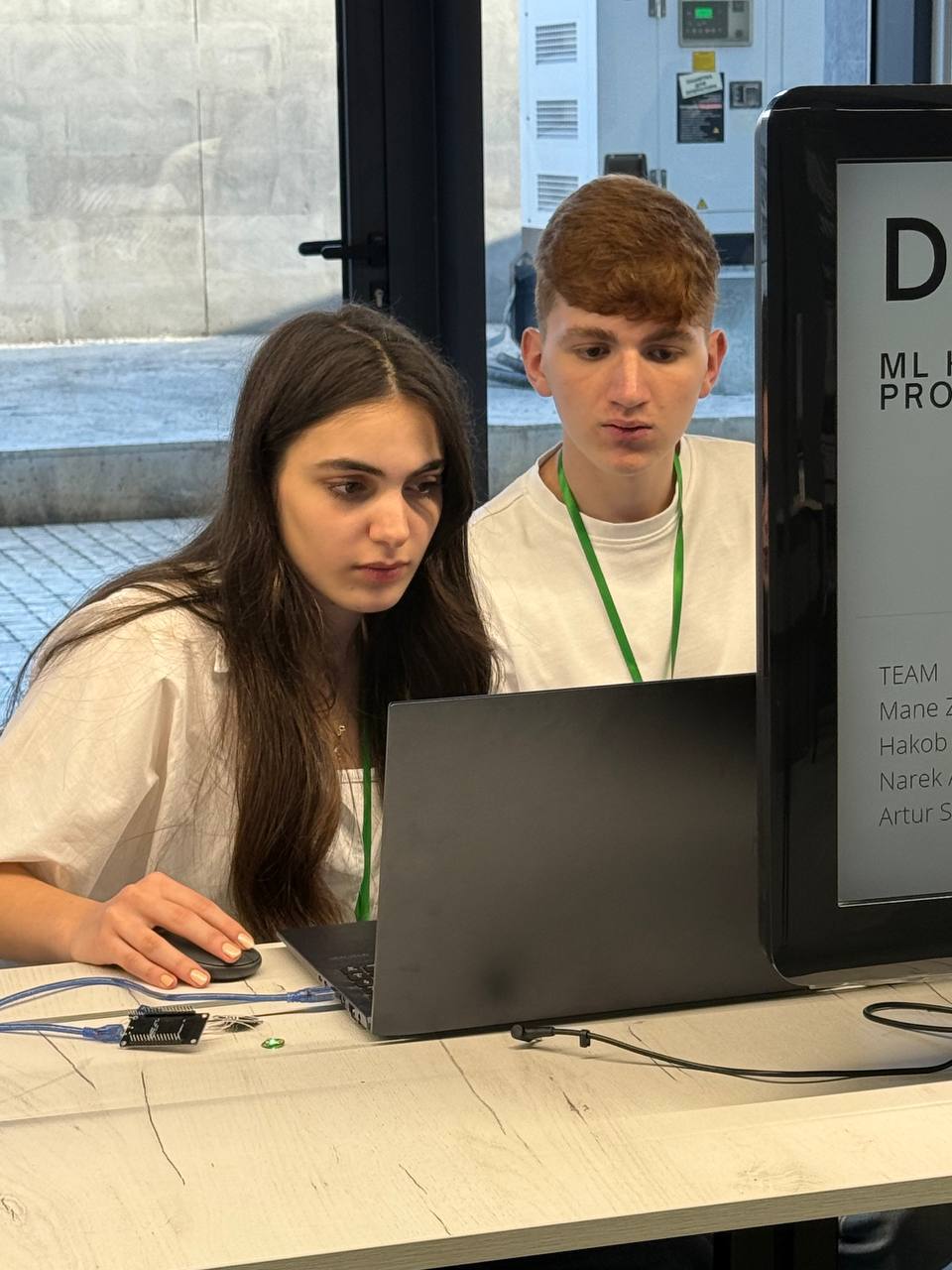
AI in Embedded Systems
AI in Embedded Systems connects artificial intelligence with real devices. Students move from Python, math, and data foundations to machine learning, computer vision, LLM/RAG concepts, model evaluation, optimization, and hardware-connected demos. The course is designed to show how AI becomes useful when it is connected to sensors, cameras, microcontrollers, and edge devices.
Advantages
- AI is taught through real data, hardware, sensors, and practical tasks.
- Students learn both model logic and deployment thinking.
- The course prepares students for robotics, smart devices, automation, and edge AI projects.
What is included in the program?
- Python, NumPy, data analysis, and math foundations for AI
- Classical machine learning and model evaluation
- Deep learning and computer vision fundamentals
- LLM, embeddings, RAG, quantization, and edge deployment concepts
- Final AI embedded project with testing and presentation
Program modules
The program is organized as a connected learning path: theoretical foundations, practical labs, prototype development, testing, and presentation.
Math and Python for AI
Data analysis notebookStudents build the foundation for AI using Python, arrays, data, probability ideas, and basic linear algebra intuition.
Machine learning
Classical ML mini-projectStudents learn data preparation, regression, classification, trees, model quality, and practical evaluation.
Deep learning and computer vision
Vision classifier or detector demoThe course introduces neural networks, image processing, computer vision, and object detection ideas.
LLM, RAG, and edge AI
RAG or edge-AI demoStudents explore embeddings, document search, RAG logic, optimization, quantization, and deployment constraints.
AI system design
Approved AI system planStudents choose a problem, dataset, model approach, hardware setup, and evaluation method.
Integrated AI prototype
Final AI embedded demoStudents collect data, train or adapt a model, connect it to hardware, optimize, test, and present.